

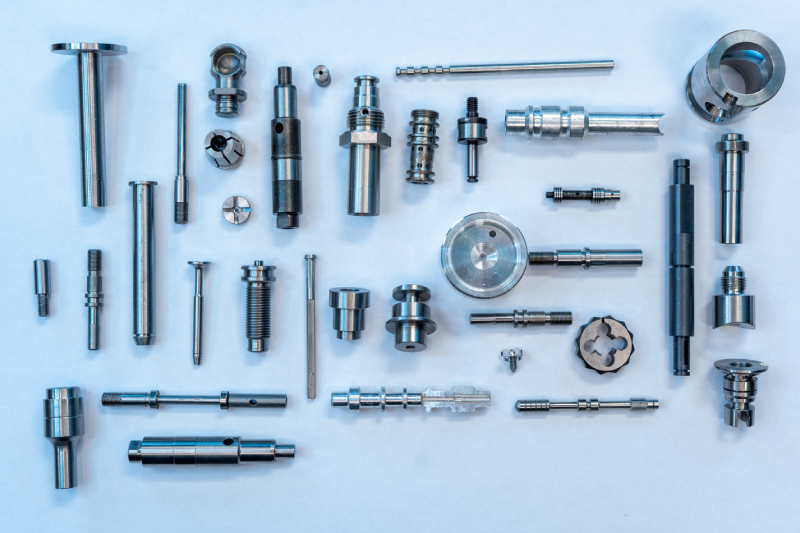
MultiTech Industries (MTI) is a precision-machined components manufacturer with one of North America’s largest fleets of Hydromat rotary transfer machines, over 70 CNC machining centers, and IATF 16949 and ISO 14001 quality certification.
We produce high-volume precision components for automotive, hydraulic/pneumatic, and industrial applications from brake system fittings and fuel rail components to sensor bosses, specialty fasteners, and hydraulic connectors with station-to-station repeatability within ±0.0002″ and annual volumes exceeding 1,000,000 units per program.
Precision Machined Components Built for Demanding Programs
Precision machining at MTI is engineered around the requirements of high-volume programs that cannot tolerate dimensional drift, tooling downtime, or supplier quality escapes. Every component is produced using in-house tooling and cutting technology, with proprietary real-time monitoring software tracking dimensional variation at the machine level, catching anomalies before they produce non-conforming parts.
Our Hydromat rotary transfer machines are the core of our high-volume capability. With 31 Hydromats in operation, MTI provides a level of Hydromat capacity and expertise that most precision machining suppliers cannot match. For programs requiring 50,000 units per year or more, Hydromat machining delivers the lowest per-piece cost, the tightest tolerances, and the greatest consistency across large production runs.
MTI’s fully vertical approach of in-house engineering, tooling, machining, and quality inspection gives design engineers and procurement teams a single accountable source from print to ship.
MTI's Precision Machining Capabilities
MTI operates a broad range of high precision machining capabilities, allowing our engineering team to recommend the most cost-effective process for your component geometry, material, and volume requirements. The table below summarizes our core capabilities:
| Capability | Details |
| Hydromat Fleet | 31 Hydromat rotary transfer machines (one of North America’s largest collections) |
| CNC Machines | 70+ machines including single-spindle, multi-spindle, twin-spindle, and CNC Swiss (Tsugami, Miyano, Citizen, and others) |
| Part Size Range | 1mm diameter minimum (CNC Swiss / Metal Forming Division) through 64mm maximum
For projects with 65mm or beyond, please contact our engineering team. |
| Tolerances | Station-to-station repeatability ±0.0002″ |
| Production Volumes | Prototype through 1,000,000+ components per year; Hydromat optimized for 50,000+ units/year |
| Materials Processed | Steel alloys, high-performance super alloys, stainless steel, aluminum, brass, copper, titanium, and other ferrous and non-ferrous metals |
| In-House Tooling | Proprietary tooling designed and maintained in-house for all production programs |
| Wire EDM | Specialized in-house wire EDM capability for precision tooling and finished-part profiles |
| Certifications | IATF 16949
ISO 14001 |
| Monitoring Technology | Proprietary computer-integrated real-time quality monitoring during all production runs; in-house quality laboratory for dimensional inspection and random pull analysis |
Machining Operations Performed
MTI’s Hydromat rotary transfer machines and CNC machining centers perform a full range of precision machining operations, including:
| Drilling | Cross-Drilling | Boring |
| Milling | Threading | Turning |
| Reaming | Facing | Grooving |
| Knurling | Tapping | Parting / Cutoff |
This breadth of in-machine capability means that components requiring multiple features including threaded bores, cross-drilled passages, milled flats, and turned profiles, can often be completed within a single Hydromat cycle, reducing downstream secondary operation requirements for procurement teams managing supplier chain complexity.
Precision Machined Components for Critical Applications
MTI has extensive experience producing precision machined components for automotive, hydraulic and pneumatic, and industrial applications. These components require a high degree of dimensional accuracy, consistent mechanical properties, and strict process control to meet OEM and Tier 1 supplier specifications.
Automotive Precision Components
MTI produces precision machined automotive components, including brake system fittings, fuel rail components, transmission parts, and steering pinions. These parts require tight tolerances and high-volume consistency across production runs that can reach millions of units per year. Our Hydromat rotary transfer process is well-suited to rotationally symmetric automotive components with multiple machined features, where station-to-station repeatability is critical to fit-and-function in the vehicle.
Hydraulic & Pneumatic Components
MTI supplies precision machined valves, fittings, connectors, and manifold bodies for hydraulic and pneumatic systems. These components require leak-free sealing surfaces, tight bore tolerances, and consistent thread geometry, all of which are achievable and repeatable on MTI’s Hydromat machines. Our in-process monitoring software verifies critical dimensions in real time, preventing non-conforming parts from advancing through the production run.
Industrial & Electrical Components
MTI produces sensor bosses, armatures, cores, and specialty fasteners, including screws, bolts, and nuts, for industrial and electrical applications. These components often require precise thread integrity, surface finish, and dimensional consistency across very high annual volumes. MTI’s Hydromat and multi-spindle CNC capabilities are particularly well-suited to high-volume fasteners and small-diameter components, including parts as small as 3mm in diameter produced through our MultiTech Metal Forming Division.
Hydromat Rotary Transfer vs. CNC Machining: Choosing the Right Process
MTI operates both Hydromat rotary transfer machines and a full suite of CNC machining centers. For design engineers and procurement managers selecting a machining process, the following comparison covers the key decision factors:
| Factor | Hydromat Rotary Transfer | CNC Machining (Single / Multi / Swiss) |
| Ideal annual volume | 50,000+ units/year | Prototype through mid-volume runs |
| Cycle time | Fastest — simultaneous multi-operation | Flexible — sequential operations |
| Per-piece cost at volume | Lowest at high volume | Competitive at lower volumes |
| Part complexity | Best for multi-feature rotational parts | Broader geometry flexibility |
| Secondary operations | Typically eliminated in a single cycle | May be required for complex features |
| Station-to-station tol. | ±0.0002″ (Hirth ring coupling) | |
| Setup / tooling cost | Higher upfront tooling investment | Lower setup cost, faster to first part |
In-House Tooling and Engineering
At MTI, tooling quality determines part quality. All cutting tools, fixtures, and proprietary monitoring software are developed and maintained in-house, giving MTI direct control over tooling quality, program lead times, and the response speed needed when a running program requires a modification or design change.
MTI’s engineering team engages with customers from the earliest stages of a new program. By reviewing component geometry, material specifications, and production volume requirements before tooling is committed, MTI identifies potential manufacturability issues early — reducing costly rework and shortening overall program launch timelines. For supplier development professionals managing new source qualification, this design-for-manufacturability (DFM) engagement is available from the first engineering conversation.
Engineering and Quality
Quality Certifications
- ISO 14001:2015: Quality management system certification
- IATF 16949:2016: Automotive quality management system certification
Quality Processes
- Real-time in-process monitoring: Proprietary computer-integrated software monitors dimensional quality at the machine level during every production run, flagging variation before non-conforming parts are produced
- In-house quality laboratory: Components undergo both in-production real-time inspection and random pull analysis in MTI’s dedicated quality lab
- Advanced Product Quality Planning (APQP): Structured quality planning from design intent through production validation, available for new program launches
Value-Added Capabilities
MTI provides a range of complementary manufacturing capabilities that allow complex programs to be managed under one roof, reducing supplier handoffs, compressing lead times, and maintaining process control throughout:
- Wire EDM. In-house wire EDM capability used for precision tooling components and, where required, for finished parts requiring tight-tolerance slots or profiles.
- CNC Machining (70+ machines). Supports both toolroom operations and secondary machining of components requiring drilled, tapped, or milled features that fall outside Hydromat cycle scope.
- Metal Forming Division. Expanded CNC capabilities for parts as small as 1mm in diameter, maintaining the tightest tolerances for miniature precision components.
Working with MTI: What to Expect
For new programs, MTI follows a structured development process designed to reduce launch risk and accelerate time to production:
- Application Review. MTI’s engineering team reviews your part drawing, material specification, annual volume requirement, and any customer-specific quality requirements before providing feedback or a quotation.
- DFM Feedback. Where opportunities exist to reduce tooling cost, improve machinability, or increase process robustness without compromising function, MTI provides design feedback before quoting.
- Quotation: Quotations cover tooling investment and per-piece pricing across stated annual volumes.
- Tooling Design and Build. All tooling is designed and built in-house.
- First Article and PPAP. MTI supports full PPAP submission
- Production. Ongoing production is supported by real-time process monitoring, in-process inspection, and preventive tooling maintenance, all managed within MTI’s certified quality system.
Request a Quote for Your Precision Machined Components Program
MTI is accepting new programs for Hydromat rotary transfer machining, CNC precision machining, and related value-added services across automotive, hydraulic, pneumatic, and industrial applications.
To discuss your requirements with our engineering team, submit a request for quote.
Frequently Asked Questions
The following questions are commonly asked by design engineers, procurement managers, and supplier development professionals evaluating MTI as a precision machined components supplier.
Contact Us
Request a quote today to discuss your next precision machined components project.