
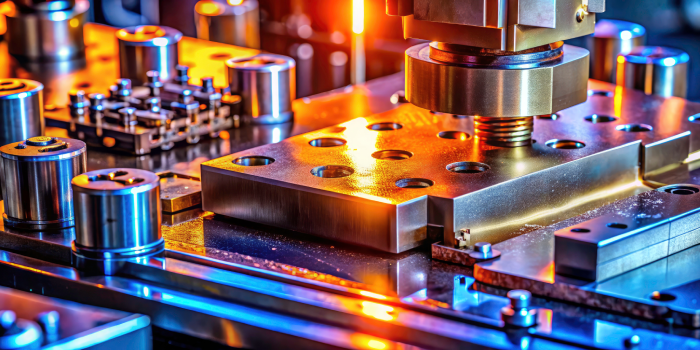
Progressive Die Stamping

Progressive die stamping is a versatile and cost-effective manufacturing process for producing high-volume precision metal components. During the process, a continuous metal strip moves through a series of workstations, where operations such as bending, punching, and coining progressively form the part. At the final station, the completed component is separated from the strip and is ready for use.

MultiTech Industries (MTI) specializes in progressive die stamping for demanding industries, including automotive, aerospace, agriculture, defense, and more. With advanced stamping presses, in-house tooling capabilities, and real-time process monitoring, we produce stamped components with the speed, precision, and reliability our customers require.

Our Progressive Stamping Process: Efficiency at Scale

Progressive die stamping performs multiple operations in a single pass. As the metal strip advances through a custom-engineered die, each station completes a specific task, such as punching, forming, coining, or drawing. By the final station, the finished part is cut from the strip and ready for the next stage.

This continuous process reduces cycle times, minimizes handling, and delivers consistent part quality at high production volumes.

Benefits of Progressive Die Stamping

Progressive die stamping offers numerous advantages compared to other manufacturing methods. The process combines efficiency and accuracy, making it a preferred choice for high-volume production across industries.

Key benefits include:

  • Faster production speeds. The continuous feed of strip metal through multiple stations enables the formation of multiple features in a single pass, reducing cycle times and supporting high-volume production.
  • Lower material waste. Optimized die designs make efficient use of sheet metal, generating less scrap than subtractive processes and lowering raw material costs.
  • Dimensional accuracy. The process is designed to maintain uniform tolerances across parts, so components meet specifications without extensive secondary work.
  • Broader design freedom. Progressive die stamping can accommodate a range of part geometries. The process allows multiple features, from holes and bends to more complex shapes, to be formed in sequence as the strip advances through the die.

Our Progressive Die Stamping Capabilities

At MultiTech Industries, our progressive die stamping operations combine decades of tooling expertise with advanced technology to deliver precision quality, repeatability, and efficiency for high-volume production. We maintain a press capacity of 25 tons to 600 tons. The materials we can work with include ferrous and non-ferrous metals from .005 in. to .250 in. thick, which include aluminum, brass, copper, molybdenum, nickel, steel, stainless steel, titanium, and more.

Our Smart Pak monitoring systems track press performance, production rates, and quality in real time, allowing us to detect process variations immediately. Combined with precision tooling and process control, this helps us maintain tight tolerances and repeatable results throughout long production runs.

Progressive Die Stamping Operations We Perform [H2]

Depending on your part requirements, we can utilize progressive die stamping to perform one or more of the following operations within a single setup:

Blanking The outer profile of the part is cut from the strip, establishing the finished shape.
Bending The strip is formed to create angles, flanges, or contoured profiles in a single stroke.
In-die tapping Threaded features are created directly within the die – no secondary machining required.
Piercing and Punching These operations can be used to create holes, slots, or cutouts in the material.
In-die fastener assembly Hardware is inserted and permanently set within the die during stamping, combining two processes into one.
Coining High-pressure forming produces very tight tolerances and smooth surfaces on specific features.
Embossing Raised or recessed features, such as logos, ribs, or identification marks, are formed into the surface without cutting.
Drawing Material is pulled into a die cavity to create cup shapes, channels, or three-dimensional profiles.
In-die sensors Integrated die sensors monitor material feed, tooling condition, and part presence in real time to prevent defects.


Applications: Critical Automotive Airbag Boxes and Seat Belt Components


Some of the most demanding automotive stamping applications involve safety-critical components, where dimensional accuracy and material integrity can be essential. MTI supports Tier 1 suppliers and OEMs with precision-stamped components for restraint systems, including:

  • Airbag housings and boxes. Stamped to ensure consistent geometry, accurate hole patterns, and precise flange profiles. MTI is an established airbag stamping supplier with IATF 16949:2016 certification.
  • Knee airbag assemblies. Stamped brackets and housing components supported by in-house tooling and DFM expertise to improve manufacturability before production.
  • Seat belt components. Processed for repeatability across materials, with value-added services that can be utilized, such as plating and heat treating.

In-House Tooling & Die Design

At MTI, high-quality stamping starts with high-quality tooling. We design, build, and maintain all of our progressive dies in-house, giving us full control over accuracy, consistency, and lead times. Our in-house tool room features CNC machining centers and advanced wire EDM systems, with 20+ experienced toolmakers who ensure every die is built with quality in mind and for long-term sustained performance.

This in-house approach shortens development cycles, reduces downtime, and allows us to adapt quickly to customer design changes. By keeping tooling and stamping under one roof, MTI is able to consistently deliver high-quality, cost-effective production for customers across the Midwest and Southeast United States.

Value-Added Capabilities

To supplement our progressive die stamping capabilities, MTI provides a range of value-added services to streamline production:

  • Wire EDM
  • CNC machining
  • Deburring
  • Laser cutting
  • Plating, passivating, and heat treating

These capabilities allow us to manage projects from start to finish, reducing outsourcing, shortening lead times, and ensuring consistent quality. Our mechanical assembly capabilities further extend this for customers who need stamped sub-assemblies.

Engineering & Quality

Engineering and quality are at the core of MTI’s progressive die stamping operations. Our in-house engineering team works closely with customers from the earliest stages of design, reviewing applications, materials, and production requirements to ensure the manufacturability of every part. By getting involved early, we help optimize both product design and the tooling required to produce it, reducing lead times and minimizing costs.

Quality is built into every step of our process. MTI’s facilities are equipped with advanced inspection systems and follow prevention-based quality management practices such as APQP and in-process monitoring. We maintain certifications to international standards, including IATF 16949:2016 and ISO 14001:2015, and operate with a zero-defect mindset, driving consistency across high-volume runs.

Learn More about MTI’s Engineering & Quality Standards

Partner with MultiTech Industries for Your High-Volume Metal Stamping Needs

Progressive die stamping delivers the best results when backed by reliable tooling, process control, and production expertise. MultiTech Industries combines in-house tooling, advanced press capabilities, and a prevention-based quality system with assembly operations in the USA, Mexico, and India, helping manufacturers simplify their supply chain while maintaining consistent quality from prototype through production.

If you’re looking for a progressive die stamping partner for automotive or industrial components, contact us to discuss your project with our engineering team.

FAQs

What’s the difference between progressive die stamping and transfer die stamping? When is one favorable over the other?

With progressive die stamping, the part is attached to the strip through each station and is cut free at the end. It is best for small to medium parts at high volumes.

Transfer die stamping blanks the part first, then moves it station to station mechanically. It is generally suited for larger, heavier parts that need repositioning between operations.

Which industries rely most heavily on the progressive stamping process?

Automotive is a large user, covering various applications like airbag housings, driver horn plates, seat belt hardware, and structural brackets. Aerospace, defense, and agriculture also depend on the process for high-volume precision hardware.

What’s a typical lead time, and what variables affect it?

Lead time factors can include new tooling (typically several weeks, shortened by MTI’s in-house tool room), part complexity, and material availability. Once tooling is approved, production runs efficiently across our full press range. Contact us to discuss your timeline.